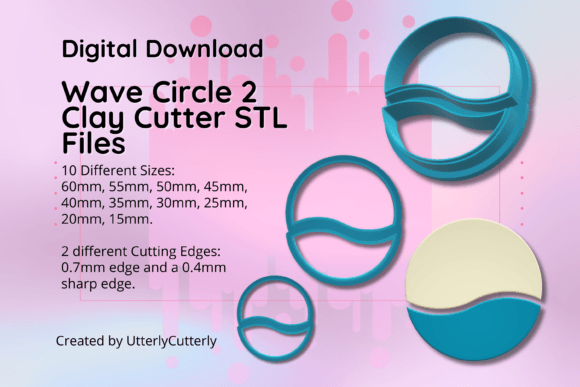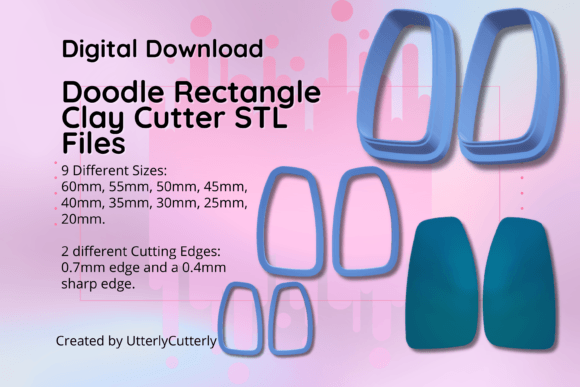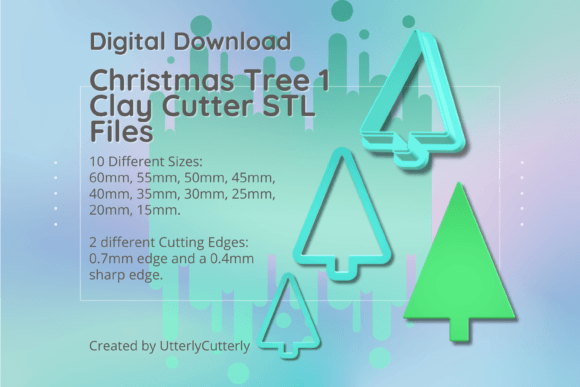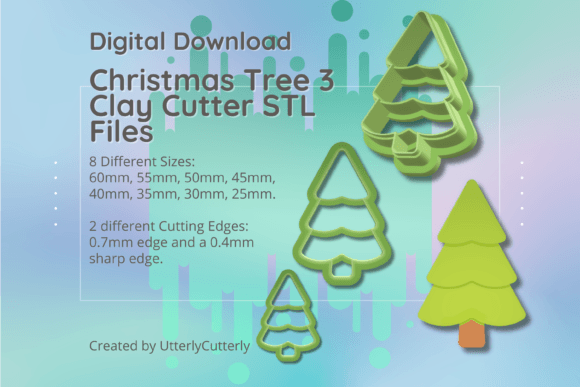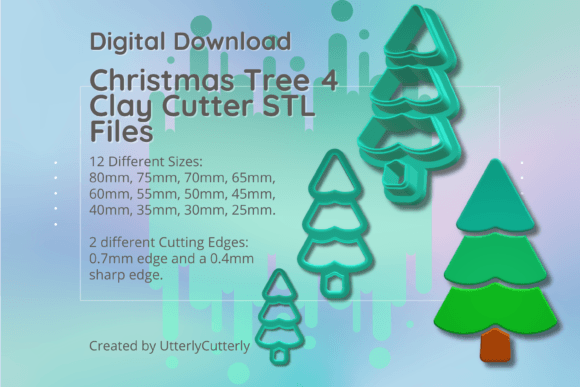
Clay Cutter STL File Christmas Tree 4- M: Optimizing Your Digital Fabrication Workflow
Getting your digital hands on a sleek bundle of Christmas tree clay cutters via an STL file download opens up immediate creative possibilities, but successful fabrication requires more than just hitting "print." The Clay Cutter STL File Christmas Tree 4- M collection is designed for versatility, offering a merry medley of styles suitable for everything from chic polymer clay earrings to festive cookie cutouts. However, the transition from digital file to physical tool is where many crafters encounter friction. Understanding the specific engineering behind these files ensures that your investment translates into high-quality, usable tools rather than a pile of failed prints.
This specific pack provides significant value through variety, including 12 different sizes ranging from 25mm to 80mm and two distinct cutting edge profiles. Whether you are a small business owner scaling production or a hobbyist exploring new designs, recognizing the technical nuances of this STL bundle is essential for achieving professional results. Below, we address common oversights and provide corrective strategies to maximize the utility of these digital assets.
Distinguishing Between Cutting Edge Profiles
One of the most frequent mistakes makers make when downloading multi-file cutter packs is assuming all STLs function identically. The Clay Cutter STL File Christmas Tree 4- M includes two fundamentally different blade geometries, and confusing them can lead to material waste or poor finishing results.
- The Standard Edge: This profile features a 0.7mm wall thickness with a 3mm thick base and a 12mm height. It is robust and ideal for softer materials like cookie dough or fondant where structural integrity during the pressing motion is paramount.
- The Sharp Edge (SE): Abbreviated as SE in the file names, this version utilizes a 1mm support wall tapering to a precise 0.4mm cutting edge. It shares the same 3mm base and 12mm height but serves a completely different purpose.
Why this matters: Using the standard 0.7mm edge on polymer clay often results in dragging or distortion because the blade is too thick to slice cleanly through cured or semi-cured clay. Conversely, using the delicate 0.4mm SE blade on stiff cookie dough may cause the edge to deform or snap under pressure. Always verify the file suffix before slicing. For jewelry making, the SE variant is non-negotiable for clean lines; for baking, the standard variant offers the durability required for repetitive use.
Sizing Accuracy and Measurement Standards
A common source of frustration in digital crafting is size discrepancy. When working with the 12 sizes included in this pack (80mm, 75mm, 70mm, 65mm, 60mm, 55mm, 50mm, 45mm, 40mm, 35mm, 30mm, and 25mm), it is vital to understand how these dimensions are derived. The cutter size is measured from the longest ends of the design, not the bounding box width or height.
If you are designing a product line with strict dimensional requirements, such as uniform earring sets or standardized packaging, relying on visual estimation in your slicer software is insufficient. Measure the actual longest span of the mesh in your CAD or slicer program before printing. This proactive step prevents the disappointment of printing a "50mm" cutter that only yields a 42mm usable area due to irregular geometry. Furthermore, because fresh STL files appear weekly in the shop, maintaining a consistent measurement protocol allows you to curate custom combos across different packs without guessing how they will nest together visually.
Print Orientation and Bed Adhesion Strategies
The geometry of a Christmas tree cutter presents unique challenges for FDM printing. Trees often have wide bases and narrow tops, or vice versa, creating uneven weight distribution. A critical error is printing these cutters flat on the build plate without considering layer strength relative to the cutting force.
While printing flat seems intuitive, the layer lines run horizontally across the blade's height. When you press down into clay or dough, you are applying force perpendicular to the layer adhesion, which is the weakest point of an FDM print. For the Clay Cutter STL File Christmas Tree 4- M, consider the following adjustments:
- Evaluate Wall Count Over Infill: With a base thickness of only 3mm, infill percentage is largely irrelevant. Focus entirely on wall perimeters. Set your slicer to at least 3-4 walls to ensure the base does not split during use.
- Brim vs. Raft: Given the 12mm height and potentially narrow contact points on tree branches, adhesion failures are common. Use a brim rather than a raft. Rafts introduce a rough surface finish on the functional base and require extensive post-processing. A brim stabilizes the print while keeping the bottom surface glass-smooth against the build plate.
- Nozzle Selection: If you are printing the Sharp Edge (SE) variants with a 0.4mm tip, you are pushing the limits of extrusion width. Switching to a 0.25mm nozzle for SE files dramatically improves edge definition and reduces the need for post-print sanding. If you must use a 0.4mm nozzle, enable "thin wall detection" in your slicer to prevent gaps in the cutting edge.
Material Compatibility and Safety Considerations
Digital files are agnostic to safety, but your application should not be. There is a dangerous misconception that any 3D printed object is food-safe by default. The STL file defines geometry, not hygiene. Layer lines in 3D prints harbor bacteria that cannot be cleaned effectively, regardless of the filament type.
If you intend to use the Clay Cutter STL File Christmas Tree 4- M for cookies or fondant, treat the printed tool as a prototype or mold-maker rather than a direct food contact surface. Professional bakers often use printed cutters to create silicone molds or stamp impressions into food-grade silicone sheets, which then serve as the safe interface. Alternatively, coat the cutter in a certified food-safe epoxy resin, ensuring full coverage of all layer lines. For polymer clay, metal clay, or soap crafting, standard PLA or PETG is perfectly adequate, but always dedicate specific printers and nozzles to non-food applications to avoid cross-contamination.
Managing Embossing Details and Tolerances
If your specific variation of the Christmas Tree 4- M includes embossing elements, tolerance management becomes the primary factor in success. Embossing details on clay cutters require negative space that accounts for material expansion and printer tolerances. A detail that looks crisp in the 3D viewport may fuse into a solid lump when printed if the gaps are smaller than your nozzle diameter.
Before committing to a full batch print, run a tolerance test. Print a single cutter at 100% scale and test it with your intended medium. If the embossed details are muddy, do not simply scale up the model, as this alters the specified sizes. Instead, adjust your flow rate or horizontal expansion settings in the slicer to open up internal gaps. Sometimes, reducing horizontal expansion by -0.05mm to -0.1mm creates just enough clearance for intricate tree branch details to render correctly without compromising the outer cutting dimension.
Curating a Sustainable Digital Inventory
With new STL files popping up like tinsel every week, digital hoarding is a genuine risk. Downloading dozens of cutter packs without a testing protocol leads to cluttered libraries filled with unverified assets. Adopt a "test-first" workflow for the Clay Cutter STL File Christmas Tree 4- M and future acquisitions. Create a standardized test print that evaluates edge sharpness, base stability, and size accuracy immediately upon download.
Tag verified files in your storage system with notes regarding optimal print settings and material pairings. This transforms a generic download folder into a curated manufacturing library. By validating each size and edge type individually, you ensure that when inspiration strikes or a client order arrives, you reach for a tool that performs predictably. This disciplined approach separates professional creators from casual hobbyists, turning affordable digital downloads into reliable production assets.