Clay Cutter STL File Cross 2- Christian: Technical Specifications and Application Guide
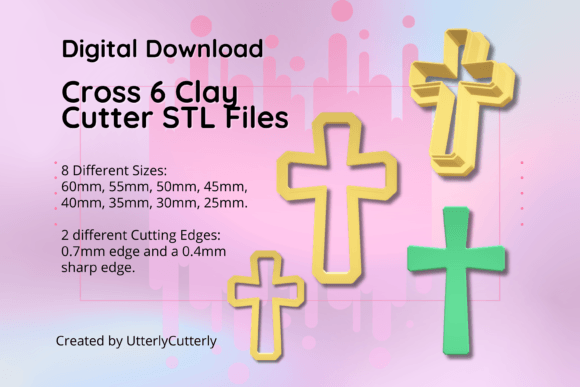
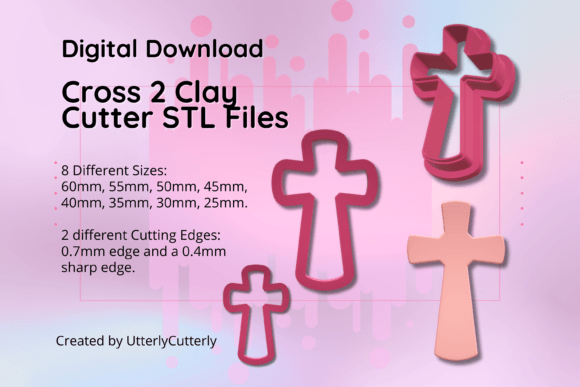
For crafters utilizing polymer clay, ceramic dough, or cookie mediums, the precision of cutting tools directly influences the quality of the final product. The Clay Cutter STL File Cross 2- Christian represents a specific digital asset designed for makers who own 3D printers and require religious iconography with exacting dimensional tolerances. Unlike generic marketplace listings that offer vague descriptions, this digital download provides a comprehensive suite of eight distinct sizes and two specialized cutting edge profiles. Understanding the technical distinctions between these profiles is essential for determining whether this specific STL pack aligns with your current production needs, material properties, and printing capabilities.
Distinguishing Edge Profiles: Standard vs. Sharp Edge (SE)
The primary decision factor when evaluating the Clay Cutter STL File Cross 2- Christian is not merely the shape, but the functional geometry of the blade. This collection includes two distinct cutter types, each engineered for different material viscosities and finishing requirements. Selecting the correct profile prevents material drag, distortion, and excessive post-processing.
The Standard 0.7mm Wall Profile
The standard variant features a 0.7mm wall thickness with a 3mm thick base and a total height of 12mm. This geometry prioritizes structural rigidity over extreme sharpness. In practical application, this thicker wall is advantageous when working with firmer polymer clays or denser cookie doughs where a thinner blade might flex or warp during pressure application. The 0.7mm edge leaves a slightly rounded cut, which can be desirable for organic-looking jewelry pieces or baked goods where a razor-sharp definition is less critical than durability. For users printing in PLA or PETG without advanced cooling, this thicker wall also reduces the risk of print failure on small cross geometries.
The Sharp Edge (SE) Variant
Labeled as "SE" within the file set, the Sharp Edge version utilizes a 1mm support wall that tapers to a precise 0.4mm cutting edge. While the base and height remain consistent at 3mm and 12mm respectively, the reduced contact surface area significantly decreases friction during the cutting process. This profile is the superior choice for soft polymer clays, translucent materials prone to fingerprinting, or detailed fondant work where clean release is paramount. However, the tradeoff is mechanical fragility; the 0.4mm edge requires careful handling and may wear faster if used repeatedly on abrasive ceramic bodies. Makers must weigh the need for pristine cuts against the potential lifespan of the tool based on their primary medium.
Evaluating Size Versatility and Scaling Constraints
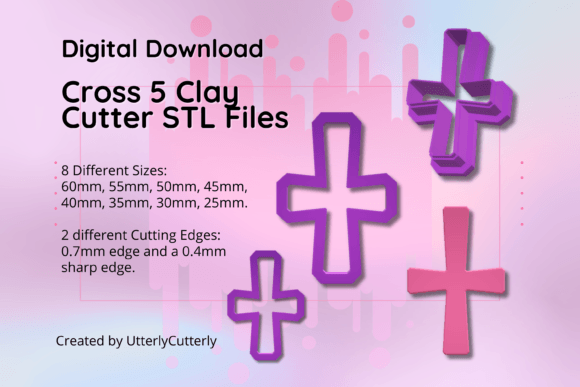
A significant advantage of acquiring the Clay Cutter STL File Cross 2- Christian as a digital asset rather than a physical tool is the immediate access to graduated sizing. Physical cutter sets often have large gaps between sizes, forcing compromises in design composition. This digital pack bridges those gaps with eight incremental sizes: 60mm, 55mm, 50mm, 45mm, 40mm, 35mm, 30mm, and 25mm.
It is important to note that these measurements refer to the longest dimension of the cross. When planning projects, crafters should verify whether their design relies on vertical height or horizontal width, as cross proportions vary. The 5mm increment between sizes allows for nuanced layering in mixed-media jewelry or tiered cookie displays. For example, a maker creating a necklace set can utilize the 25mm cutter for delicate charms and the 40mm cutter for statement pendants, maintaining visual consistency across scales.
While STL files are theoretically scalable in slicing software, deviating from these preset dimensions introduces variables. Scaling below 25mm may render the 0.4mm SE edge unprintable on standard FDM machines due to nozzle diameter limitations. Conversely, scaling above 60mm may compromise the 3mm base rigidity, requiring manual reinforcement or modified print settings. Sticking to the provided size range ensures the engineering integrity of the cutter remains intact.
Embossing Line Compatibility
For artisans incorporating texture into their work, the embossing lines in this file set are calibrated to a height of 10.5mm. This specification dictates a minimum material thickness of 1.5mm to function correctly. If the clay slab is thinner than this threshold, the embosser will bottom out, creating an uneven back surface or tearing the material. This constraint makes the Clay Cutter STL File Cross 2- Christian best suited for substantial jewelry components or decorative cookies rather than paper-thin veneers. Users accustomed to working with very thin sheets may need to adjust their conditioning process or select alternative tools with shallower relief depths.
Digital Ownership vs. Physical Alternatives
When comparing this STL download to pre-manufactured metal or plastic cutters, several operational differences emerge. Metal cutters generally offer superior longevity and heat resistance but lack the customization potential of 3D printed tools. They are also typically limited to standard shapes and sizes. The Clay Cutter STL File Cross 2- Christian fills a niche for specific religious symbolism that mass-market metal suppliers often overlook or produce only in generic forms.
Compared to purchasing physical 3D printed cutters from other vendors, owning the STL file eliminates shipping wait times and per-unit costs. Once downloaded, the marginal cost of producing a replacement cutter is merely the price of filament and electricity. This is particularly relevant for high-volume production environments where cutters may degrade or become lost. However, this convenience assumes the user possesses a calibrated printer and proficiency in slicing software. Those without reliable hardware or troubleshooting experience may find physical alternatives more cost-effective despite the higher upfront price.
Material Suitability and Best-Fit Scenarios
The utility of this specific digital collection depends heavily on the intended application. Evaluating your primary use case against the following scenarios can clarify whether this resource is appropriate.
- Polymer Clay Jewelry: Ideal fit. The SE variant provides clean cuts for earrings and pendants, while the size range supports cohesive collections. The 12mm height accommodates standard slab thicknesses comfortably.
- Cookie Decorating: Strong fit. The standard 0.7mm wall offers sufficient strength for rolled dough. The embossing feature adds value for stamped designs before baking. Note that food safety depends entirely on the user's choice of food-safe filament and post-processing sealing methods.
- Ceramic/Pottery: Conditional fit. Suitable for leather-hard clay using the standard wall profile. The SE variant is likely too fragile for grog-heavy clay bodies. Embossing depth is adequate for most hand-building applications.
- Fondant/Gum Paste: Excellent fit. The SE edge excels here, preventing sticking and ensuring crisp religious symbols for cake decoration. The non-porous nature of properly printed PLA is easier to sanitize than sintered nylon or wood.
Technical Considerations for Successful Fabrication
Owning the Clay Cutter STL File Cross 2- Christian does not guarantee successful results; print parameters matter as much as the file geometry. Because crosses contain acute angles and thin walls, orientation on the build plate is critical. Printing flat with the cutting edge facing up is standard, but may require brims to prevent warping on the larger 60mm size. Alternatively, printing vertically with the base on the plate can improve layer adhesion along the cutting edge but increases the risk of toppling without adequate supports.
Nozzle selection also plays a role. While a 0.4mm nozzle can technically print the SE variant, a 0.25mm nozzle will yield significantly better definition on the cutting edge and embossing details. Users restricted to 0.4mm nozzles may prefer the standard 0.7mm wall profile to avoid under-extrusion artifacts on the finer SE geometry. Layer height should be kept at or below 0.12mm to ensure smooth cutting surfaces; visible layer lines on the blade translate directly to texture marks on the clay.
Making an Informed Selection
The Clay Cutter STL File Cross 2- Christian serves a specific segment of the maker community: those who value dimensional precision, possess 3D printing infrastructure, and require religious motifs in multiple graduated sizes. It offers flexibility that physical tools cannot match and specificity that generic libraries lack. However, it demands technical competence to realize its potential. The dual-profile system acknowledges that no single cutter geometry suits all materials, providing options for both durability and finesse.
Prospective users should assess their current workflow honestly. If you frequently switch between soft and firm materials, having both wall thicknesses available digitally is a significant efficiency gain. If you primarily work with ultra-thin sheets or lack printer calibration confidence, alternative resources may serve you better. Ultimately, this STL pack is a professional-grade component library for informed makers, not a plug-and-play solution for casual experimentation. By understanding the interplay between edge geometry, material properties, and print parameters, users can leverage this digital asset to produce consistent, high-quality crafted goods efficiently.