Clay Cutter STL File Peach 1: Evaluating Digital Fruit Earring Tools for Polymer Clay and Baking
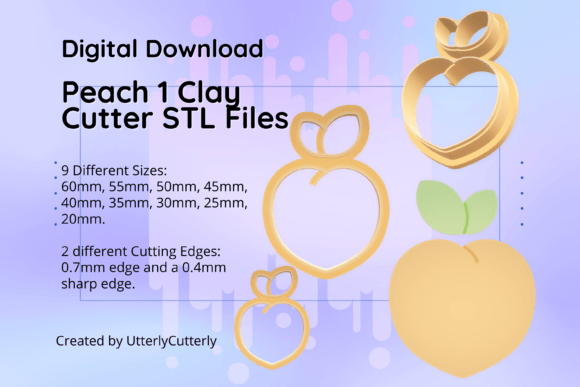
The transition from purchasing physical tools to acquiring digital assets represents a significant shift in how makers approach polymer clay jewelry and culinary decoration. The Clay Cutter STL File Peach 1 offers a specific solution for creators who own 3D printers and seek precise, repeatable shapes without waiting for shipping or relying on external manufacturers. This digital download provides the blueprint for printing peach-shaped cutters optimized for fruit earrings, pendants, barrettes, and even baking applications like cookies or fondant. Understanding the technical specifications and practical tradeoffs of this STL file is essential for determining whether it aligns with your current production workflow compared to traditional metal cutters or alternative digital formats.
Digital Versus Physical: Assessing Production Flexibility
When evaluating the Clay Cutter STL File Peach 1 against pre-manufactured alternatives, the primary distinction lies in autonomy and customization. Physical brass or stainless steel cutters offer superior durability and heat conductivity, making them the industry standard for high-volume commercial production. However, they lack flexibility; if a design requires a 45mm peach rather than the standard 50mm, a maker must source an entirely new tool. This digital asset eliminates that limitation by providing nine distinct sizes ranging from 20mm to 60mm. This granularity allows for curated collections where scale variation is intentional, such as creating graduated earring sets or nesting cookie designs.
For hobbyists and small business owners, the cost-per-unit analysis also differs significantly. While the initial investment in a 3D printer is higher than buying a single metal cutter, the marginal cost of printing additional sizes from this STL pack is negligible. Conversely, for those without printing capabilities or those requiring food-safe certification for commercial baking, physical cutters remain the safer, more compliant choice. The Clay Cutter STL File Peach 1 is best suited for users who have already integrated additive manufacturing into their studio and value design iteration over long-term tool longevity.
Technical Specifications and Printability
A critical factor in selecting any STL file is the ease of printing and the functional geometry of the model. Poorly designed files often require excessive supports, fail to adhere to the build plate, or produce fragile edges that snap during use. This specific peach cutter file addresses these common pain points through two distinct edge profiles included in the download:
- Standard Edge (0.7mm Wall): Features a 0.7mm wall thickness with a 3mm thick base and 12mm height. This profile prioritizes structural integrity and ease of printing. It is less likely to warp during the cooling process and is ideal for softer clays or beginners still calibrating their printer settings.
- Sharp Edge (SE): Abbreviated as SE in the file set, this version utilizes a 1mm support wall tapering to a 0.4mm cutting edge. Like the standard version, it maintains a 3mm base and 12mm height. This geometry is engineered for cleaner cuts in firm polymer clay, reducing the need for post-processing trimming, but requires precise nozzle calibration and optimal bed adhesion to print successfully.
The inclusion of both profiles acknowledges that different materials and skill levels demand different tool geometries. Users comparing this to generic free repositories will find that paid, specialized files like the Clay Cutter STL File Peach 1 often include these engineered variations rather than a single, one-size-fits-all mesh.
Sizing Strategy and Application Fit
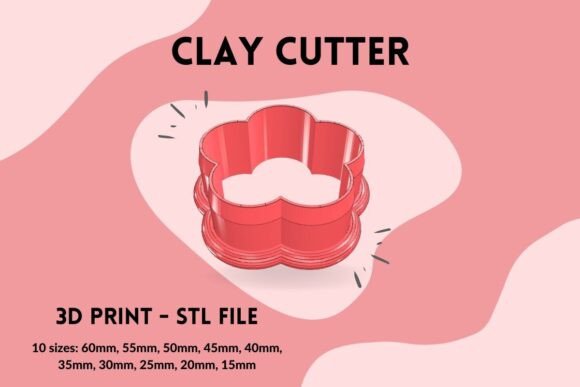
The utility of a cutter set is defined not just by its shape, but by its size range relative to intended applications. The nine sizes provided (60mm, 55mm, 50mm, 45mm, 40mm, 35mm, 30mm, 25mm, and 20mm) cover the spectrum from statement jewelry to delicate accents. When deciding which sizes to print, consider the end-use context:
- Earrings and Jewelry: Sizes between 20mm and 40mm are typically optimal for earwear. The 20mm and 25mm options work well for studs or minimalist dangles, while 35mm and 40mm serve as bold statement pieces. Note that cutter size is measured from the longest ends, so visual proportion should be verified against existing jewelry hardware.
- Pendants and Barrettes: The 45mm to 60mm range provides sufficient surface area for intricate surface treatments, mica shifts, or embedded elements. Larger cutters also accommodate thicker clay slabs without distortion.
- Culinary Uses: For cookies and fondant, the mid-to-large range (40mm–60mm) is most practical. Smaller sizes may be difficult to handle with dough due to sticking, though they can function for detailed fondant accents on cakes.
This modularity allows makers to mix and match with other STL files in their library. Unlike fixed sets sold physically, digital files enable you to print only the sizes relevant to your current project, reducing plastic waste and storage requirements.
Embossing Considerations and Material Compatibility
An important technical constraint noted in the file documentation concerns embossing lines. If the design includes internal detailing, these lines are 10.5mm tall. This specification dictates material preparation: clay must be conditioned to a thickness greater than 1.5mm to fully engage the embossing feature without bottoming out. This is a crucial decision point for comparison. If your preferred working style involves very thin sheets (under 1.5mm), this particular cutter may not render details as intended, and a shallower embosser or surface texture sheet might be a better alternative.
Furthermore, while the STL file is versatile, material compatibility varies. Polymer clay responds well to both the 0.7mm and Sharp Edge profiles. Air-dry clay, being more fibrous, may benefit from the sturdier 0.7mm wall to prevent drag marks. For food applications, users must ensure their filament is food-safe (typically PETG or specific PLA grades) and understand that 3D printed layer lines can harbor bacteria. Many bakers use printed cutters exclusively for single-use decorations or seal them with food-grade epoxy, whereas polymer clay artists face no such restrictions. Always verify safety protocols based on your specific medium before use.
Evaluating Workflow Integration and Limitations
Adopting digital cutter files like the Clay Cutter STL File Peach 1 requires integrating 3D printing into your creative workflow. This introduces variables absent in traditional tool acquisition: print time, filament consumption, and machine maintenance. A single cutter may take 20 to 45 minutes to print depending on size and infill settings. For makers needing immediate results, this latency is a significant tradeoff compared to the instant availability of physical tools.
Additionally, the lifespan of 3D printed cutters is finite. PLA and similar thermoplastics can deform if exposed to hot clay conditioning processes or left in direct sunlight. They are consumable tools rather than heirloom equipment. Makers should view this STL file as a renewable resource—the ability to reprint a worn cutter is a feature, not a flaw, but it does require ongoing access to functioning hardware. If your printer experiences frequent downtime or you lack troubleshooting confidence, the reliability of metal cutters may outweigh the customization benefits of digital files.
Making the Final Selection
The Clay Cutter STL File Peach 1 represents a strategic option for digitally-enabled makers seeking precision, variety, and cost efficiency in fruit-themed designs. It excels in scenarios requiring multiple sizes, custom edge geometries, and rapid prototyping. Its strengths lie in flexibility and the elimination of inventory constraints. However, it is not a universal replacement for traditional tools. Those prioritizing food safety compliance, extreme durability, or zero-setup convenience should continue to rely on manufactured alternatives.
Ultimately, the decision hinges on your existing infrastructure and project requirements. If you possess a calibrated 3D printer and desire a comprehensive peach cutter system for jewelry or decorative crafts, this digital pack offers a practical, scalable solution. New STL files are released weekly, suggesting an expanding ecosystem that rewards continued engagement with digital fabrication. Evaluate your current pain points—if size limitations or shipping delays are hindering your creativity, transitioning to downloadable cutter files may provide the operational leverage needed to advance your craft.