Square Clay Cutter 3D Print STL: Precision Tools for Modern Makers
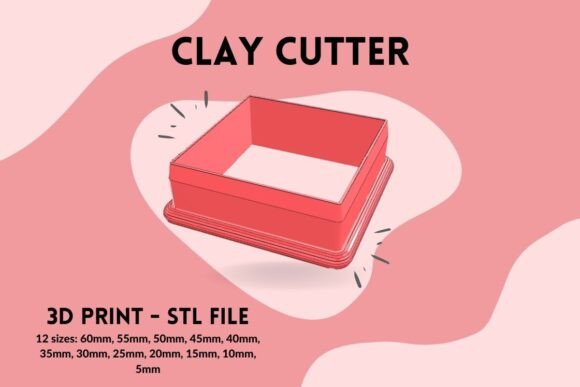
Achieving perfect geometric consistency in polymer clay work is often the difference between a hobbyist piece and professional-grade jewelry. The Square Clay Cutter 3D Print STL collection addresses this specific challenge by providing a digital suite of twelve meticulously sized cutters. Rather than relying on freehand cutting or improvised tools that result in uneven edges, this Master geometric precision set allows crafters to produce identical squares ranging from delicate 5mm accents to bold 60mm statement pieces. For 3D printing aficionados and clay artists alike, having access to these optimized STL files means you can manufacture your own high-quality studio tools on demand, ensuring that every earring, pendant, or decorative tile maintains exact uniformity.
Real-World Applications for Geometric Consistency
The primary value of this digital collection lies in its versatility across different creative disciplines. When working with polymer clay, the square shape is deceptively difficult to master manually. Corners tend to round off during conditioning, and straight edges often bow under pressure. By utilizing the Square Clay Cutter 3D Print STL files, makers can bypass these physical limitations entirely.
Contemporary Jewelry Fabrication
Modern jewelry design heavily favors clean lines and minimalist aesthetics. This cutter set is particularly valuable for creators focusing on architectural earrings or modular pendants. The smaller sizes, specifically the 5mm through 20mm range, are ideal for creating intricate mosaic patterns or stacking elements within resin bezels. Because the cutting edge is precisely .4mm thick, the resulting clay shapes have crisp boundaries without being so thin that they slice through the material uncontrollably. This balance allows for detailed surface texturing after cutting without distorting the fundamental square geometry. For makers producing collections for retail, the ability to print multiple cutters ensures that batch production remains consistent; if a cutter wears down or breaks, an identical replacement is just a print job away.
Home Décor and Surface Design
Beyond wearable art, these cutters serve a vital role in home décor projects involving ceramic-like clays or air-dry compounds. The larger sizes in the pack—ranging from 35mm up to 60mm—are perfectly scaled for creating uniform tiles for trivets, coasters, or wall installations. In these scenarios, uniformity is not just aesthetic but structural; tiles must fit together seamlessly for grouting or assembly. The rounded handle design included in the STL file becomes crucial here, as pressing larger cutters into stiffer clay requires significant force. A comfortable grip reduces hand fatigue during repetitive cutting sessions, allowing for longer, more productive workflows when tiling large surfaces.
Understanding the Digital Specifications
Before downloading and printing, it is helpful to understand how the Square Clay Cutter 3D Print STL has been engineered for functional performance rather than just visual appeal. The set includes twelve distinct sizes: 5mm, 10mm, 15mm, 20mm, 25mm, 30mm, 35mm, 40mm, 45mm, 50mm, 55mm, and 60mm. It is important to note that these measurements reflect the height of the cutter wall, which directly correlates to the maximum thickness of clay you can cleanly cut. This specification prevents the common issue where clay sticks inside shallow cutters or deforms because the tool isn't tall enough to clear the material.
The blade width is standardized at .4mm across all sizes. This dimension was chosen deliberately to match standard nozzle diameters, ensuring that the slicing edge prints as a solid, continuous perimeter rather than a fragile infill pattern. While sharp enough to define edges clearly, this thickness provides enough structural integrity to withstand repeated use without snapping. The handles feature a rounded ergonomic profile, distinguishing these functional tools from generic cookie cutters that often have flat, uncomfortable tops. This design consideration acknowledges that clay crafting involves varying degrees of resistance depending on the material's temperature and firmness.
Optimizing Your 3D Print for Functional Use
While the STL files are tested for quality before release, the final performance of your Square Clay Cutter 3D Print STL depends heavily on your specific hardware and slicer configuration. These are functional mechanical parts, not decorative statues, and should be treated accordingly during fabrication.
- Nozzle Selection: The recommended settings assume a 0.4mm nozzle. Using a larger nozzle may result in a blade edge that is too blunt for precise clay work, while a smaller nozzle might make the walls too fragile. If you must deviate, adjust your line width settings to ensure the cutting edge remains a single, solid extrusion path.
- Print Speed and Cooling: The suggested print speed of 150 mm/sec is achievable on modern high-speed printers, but those with older machines should prioritize layer adhesion over speed. Since these cutters will undergo lateral stress during use, weak layer bonds are the most common failure point. Ensure adequate cooling for the bridge sections near the blade tip to prevent sagging, which would ruin the flatness required for even cuts.
- Material Considerations: PLA is generally sufficient for polymer clay due to its stiffness and ease of printing. However, if you plan to use these cutters with warmer materials or intend to wash them frequently in warm water, PETG or ABS may offer better longevity. Be aware that different materials shrink at different rates; always print a test square and measure it against your calipers to verify dimensional accuracy before printing the full set.
- Bed Adhesion: Because the cutting edge is narrow, first-layer adhesion is critical. Use a brim if necessary to prevent warping at the base. A warped cutter will never sit flush against your work surface, leading to incomplete cuts and wasted clay.
Practical Considerations and Limitations
It is essential to approach this digital product with realistic expectations regarding post-processing and safety. As a digital download, no physical item will be shipped; you receive only the files needed to create the tools yourself. This model offers immense flexibility but places the responsibility of manufacturing quality on the user. You may need to fine-tune your slicer’s flow rate or retraction settings to eliminate stringing on the thin blade edges, as excess plastic artifacts can mar the surface of soft clay.
Furthermore, while these cutters are designed for clay, users should exercise caution regarding food safety. Unless you are using certified food-safe filament and have verified that your printer’s hotend and nozzle are free from heavy metals and contaminants, these tools should be reserved strictly for craft applications like polymer clay, metal clay, or soap making. The layered nature of 3D prints can harbor bacteria, making them unsuitable for direct food contact without proper sealing and certification. Always label your printed tools clearly to distinguish between craft-only and food-safe equipment in a mixed-use studio environment.
Ultimately, the Square Clay Cutter 3D Print STL collection represents a convergence of digital fabrication and traditional craftsmanship. By leveraging these precise, scalable tools, makers can elevate their technical execution and explore geometric designs that were previously impractical to produce by hand. Whether you are prototyping new jewelry concepts or scaling up production for a holiday market, having a reliable, self-replicating toolkit empowers you to focus less on correcting imperfections and more on creative expression.