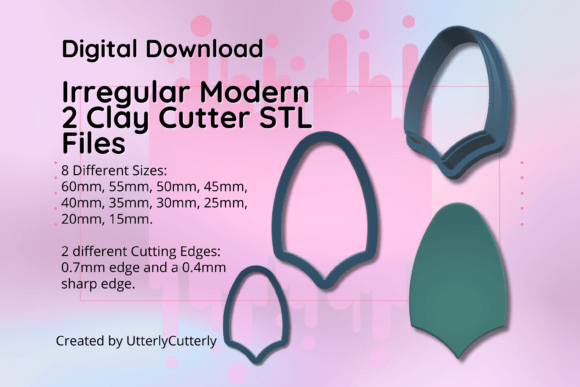
Clay Cutter STL File Irregular Modern 2: Digital Assets for Custom Fabrication
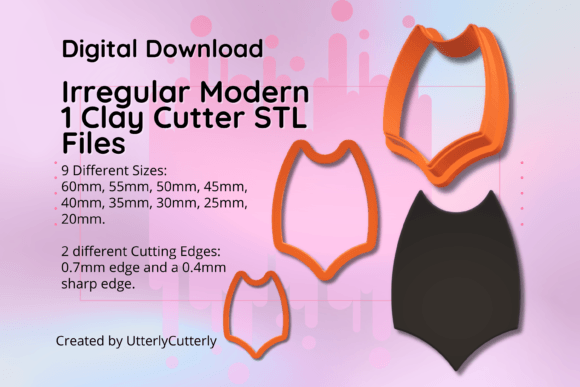
In the evolving landscape of digital fabrication and small-scale manufacturing, access to high-quality, specialized tools is often the differentiator between amateur results and professional-grade output. The Clay Cutter STL File Irregular Modern 2 represents a functional digital asset designed specifically for creators who utilize FDM or resin 3D printing to produce custom shaping tools. Unlike generic geometric shapes that saturate open-source repositories, this collection focuses on irregular modern aesthetics, providing a curated library of forms suitable for polymer clay jewelry, ceramic work, and culinary applications. For entrepreneurs, educators, and serious hobbyists, the value lies not just in the design itself, but in the technical specifications that ensure printability and functional longevity.
Technical Specifications and Print Optimization
The primary advantage of acquiring a professionally prepared STL pack over free alternatives is the assurance of dimensional accuracy and structural integrity. This specific file set addresses common failure points in printed cutters through two distinct edge profiles and a comprehensive size gradient. Understanding these specifications is essential for selecting the correct variant for your intended material and printer capabilities.
Dual Edge Profiles for Material Versatility
The collection includes two distinct cutting edge configurations, each engineered for different use cases and material viscosities. Recognizing when to deploy each type is critical for workflow efficiency.
- Standard Wall (0.7mm): This variant features a 0.7mm wall thickness with a 3mm thick base and a total height of 12mm. The increased wall mass provides rigidity, making it ideal for stiffer polymer clays or doughs that require significant downward pressure. The 3mm base ensures the cutter does not flex during use, maintaining the integrity of the irregular geometric shape.
- Sharp Edge (SE): Abbreviated as SE in the file naming convention, this version utilizes a 1mm support wall tapering to a precise 0.4mm cutting edge. Like the standard version, it maintains a 3mm base and 12mm height. The reduced contact area at the cutting face allows for cleaner releases in softer materials and finer detail retention, though it requires careful handling to prevent deformation during the demolding process.
Comprehensive Size Scaling
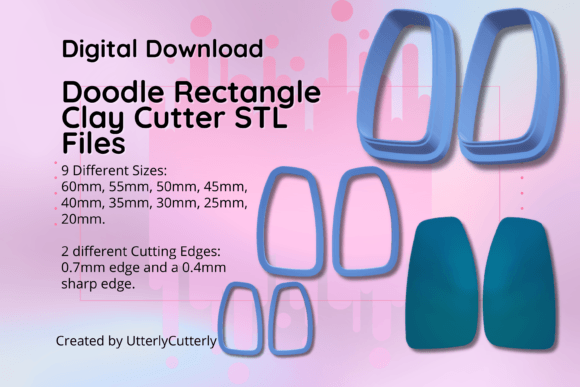
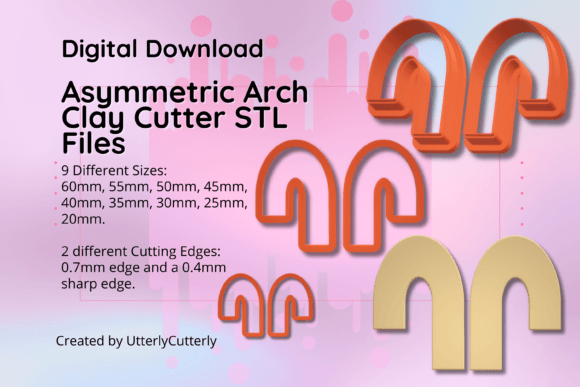
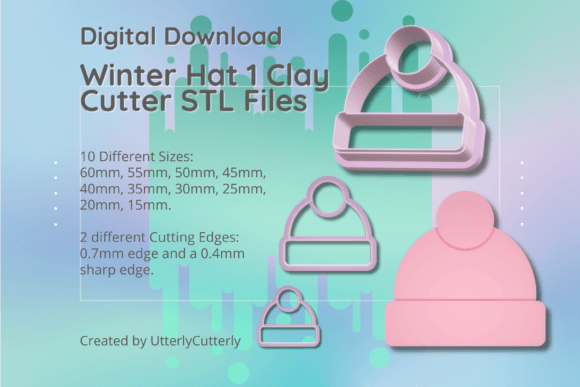
Consistency across scales is a frequent challenge in parametric design. This pack resolves that issue by offering ten discrete sizes measured from the longest endpoints: 60mm, 55mm, 50mm, 45mm, 40mm, 35mm, 30mm, 25mm, 20mm, and 15mm. This granular scaling allows makers to create cohesive product lines—such as graduated earring sets or nested cookie arrangements—without manually resizing files, which often introduces artifacts or compromises wall thickness ratios.
Practical Applications and Workflow Integration
The utility of the Clay Cutter STL File Irregular Modern 2 extends beyond simple shape creation. For professionals and small business owners, these files serve as foundational assets in a broader production ecosystem. The irregular modern aesthetic fills a specific niche in contemporary craft markets, moving away from traditional symmetry toward organic, architectural forms that currently drive engagement in handmade jewelry and artisanal food sectors.
Jewelry and Accessory Fabrication
For polymer clay artists, the 15mm to 30mm range is particularly relevant. The Sharp Edge (SE) variants are recommended here, as they minimize drag on conditioned clay, reducing the need for post-processing sanding. When working with translucent or metallic clays where surface finish is paramount, the clean release provided by the 0.4mm edge can significantly reduce labor time. Users should note that if utilizing embossing features within the design, the embossing lines are 10.5mm tall. Consequently, clay must be conditioned to a thickness exceeding this measurement to avoid bottoming out, ensuring the negative space translates correctly to the final piece.
Culinary and Ceramic Adaptation
Larger sizes (40mm–60mm) transition effectively into culinary and ceramic applications. For cookie production, the Standard Wall (0.7mm) is generally superior due to the abrasive nature of sugar crystals and the density of dough. In ceramics, both edge types function well depending on the clay body's grog content; however, users should apply appropriate release agents regardless of the STL variant chosen. The 12mm height accommodates most rolled slab thicknesses used in hand-building, providing adequate leverage for lifting without distorting the wet clay.
Evaluating Quality and Usability Factors
When integrating third-party STL files into a commercial or educational workflow, several quality metrics determine long-term viability. Based on the provided specifications and design intent, several factors warrant consideration.
Printability and Tolerance
The specified dimensions assume a well-calibrated machine. A 0.4mm cutting edge on the SE variant pushes the limits of standard 0.4mm nozzles. Users with older printers or those unable to maintain consistent flow rates may experience under-extrusion on these fine details. It is advisable to run a tolerance test print before committing to a full batch. Conversely, the 0.7mm standard wall falls comfortably within the reliable printing envelope of most consumer-grade FDM machines, making it the safer choice for makers with variable equipment quality.
Design Consistency and Expansion
A significant strength of this collection is its modularity. The description notes that new files are added weekly, suggesting an active development cycle. For business owners building a brand identity around specific geometric motifs, this ongoing expansion reduces the R&D burden of designing proprietary tools. However, reliance on external updates requires verifying that new additions maintain the same base and height parameters (3mm/12mm) to ensure compatibility with existing storage solutions and production jigs.
Audience Fit and Strategic Considerations
Not every digital asset suits every user profile. Evaluating whether the Clay Cutter STL File Irregular Modern 2 aligns with your specific goals requires honest assessment of your current capabilities and market positioning.
Ideal User Profiles
- Small Business Owners: Those selling polymer clay jewelry or custom cookies who need to differentiate their product line from competitors using mass-produced metal cutters. The ability to print replacement tools on-demand eliminates supply chain dependencies.
- Educators and Workshop Leaders: Instructors teaching modern sculptural techniques benefit from having multiple size variants available simultaneously, allowing students to experiment with scale without waiting for shared resources.
- Serious Hobbyists: Makers transitioning from purchased tools to custom fabrication who understand basic slicer settings and printer maintenance.
Limitations and Realistic Expectations
While versatile, these STL files are not universal solutions. The irregular geometry may present challenges for automated batch processing compared to simple circles or squares. Additionally, the plastic nature of 3D printed cutters means they have a finite lifespan compared to stainless steel; they are consumable tools rather than permanent fixtures. Users must factor reprinting costs and time into their operational overhead. Furthermore, those without access to a 3D printer will find no immediate value, as this is purely a digital deliverable requiring local fabrication infrastructure.
Making an Informed Acquisition Decision
The Clay Cutter STL File Irregular Modern 2 offers a practical solution for creators seeking specific, contemporary forms without the learning curve of CAD modeling. Its dual-edge system and extensive sizing demonstrate thoughtful engineering aimed at real-world application rather than mere visual novelty. Success with this asset depends largely on matching the correct file variant to your material and ensuring your printing setup can handle the specified tolerances. For professionals and dedicated enthusiasts operating within the modern craft economy, it represents a cost-effective method to expand tooling capabilities while maintaining creative control over form and function. Evaluate your current inventory gaps, verify your printer’s calibration status, and consider how irregular modern geometry aligns with your upcoming project roadmap before adding this digital resource to your library.