Clay Cutter STL File Long Chevron: Geometric Precision for Digital Fabrication
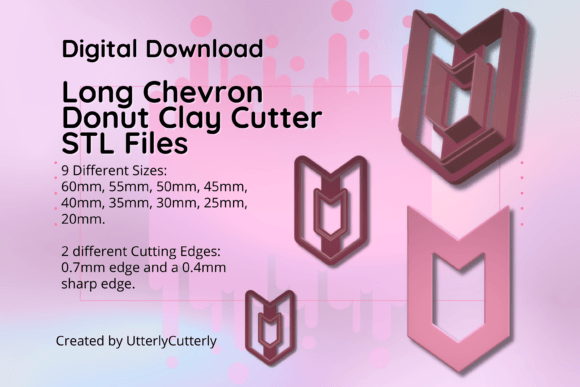
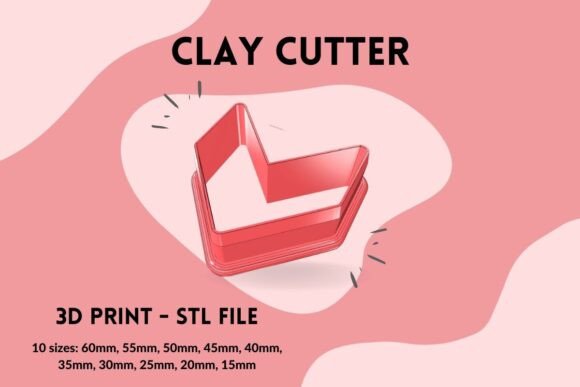
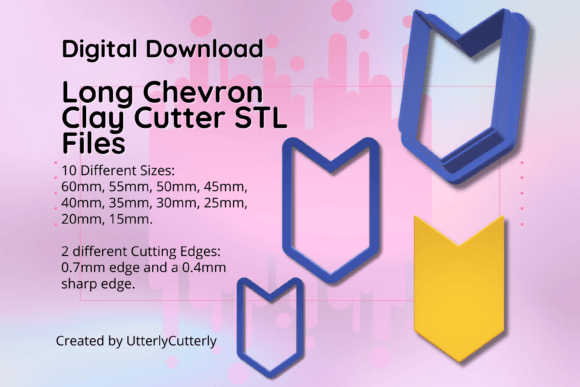
The intersection of digital design and tactile craftsmanship has created a new standard for independent makers. For professionals and hobbyists utilizing polymer clay, ceramic materials, or even culinary mediums, the quality of tools directly dictates the finish of the final product. The Clay Cutter STL File Long Chevron - Geom represents a functional asset in this ecosystem, offering a downloadable blueprint for manufacturing precise, geometric cutting tools. Rather than relying on mass-produced metal cutters with limited size variations, this digital file pack allows users to fabricate a comprehensive suite of ten distinct sizes, ranging from 15mm to 60mm. This level of granularity is essential for creators who require consistent aesthetic scaling across jewelry collections, cookie sets, or mixed-media art projects.
Technical Specifications and Print Configuration
Evaluating an STL file requires looking beyond the visual render to understand the engineering constraints intended by the designer. The Clay Cutter STL File Long Chevron - Geom is structured to accommodate different material viscosities and finishing requirements through two distinct cutter profiles. Understanding these variations is critical for achieving optimal results during the printing and application phases.
- Standard Edge Profile: This variant features a 0.7mm wall thickness with a 3mm reinforced base and a total height of 12mm. The thicker wall provides structural rigidity, making it suitable for stiffer clays or repeated use without deformation. It balances durability with cutting efficiency.
- Sharp Edge (SE) Profile: Abbreviated as SE in the file directory, this version utilizes a 1mm support wall tapering to a 0.4mm cutting edge. Like the standard version, it maintains a 3mm base and 12mm height. The reduced contact surface at the cutting point ensures cleaner slices in soft polymer clays and fondant, minimizing drag and distortion.
The dimensional consistency across the set is a significant practical advantage. With sizes incrementing by 5mm (15mm, 20mm, 25mm, 30mm, 35mm, 40mm, 45mm, 50mm, 55mm, and 60mm), users can plan nested designs or graduated patterns with mathematical certainty. Measurements are taken from the longest ends of the chevron geometry, ensuring that the spatial footprint is predictable when arranging multiple cuts on a single slab of material.
Embossing Compatibility and Material Depth
A crucial technical consideration for this specific geometry is the integration of embossing lines. In the Clay Cutter STL File Long Chevron - Geom, any included texture or embossing detail stands at 10.5mm tall. Given the total cutter height of 12mm, this leaves a clearance of only 1.5mm. Practically, this means the tool is engineered for materials thicker than 1.5mm to function correctly as an embosser-cutter hybrid. Attempting to use this tool on thinner sheets will result in the embossing feature contacting the work surface before the cutting edge fully penetrates the material, leading to incomplete cuts or damaged textures. Users must verify their clay conditioning settings or dough rolling guides against this specification to avoid production errors.
Practical Applications Across Mediums
While primarily marketed toward polymer clay artists, the utility of the Clay Cutter STL File Long Chevron - Geom extends into several professional and domestic niches. The long chevron shape is inherently modern and geometric, fitting current design trends in fashion accessories and artisanal food presentation.
Jewelry Manufacturing: For earring designers, the ability to print cutters in 15mm, 20mm, and 25mm sizes allows for the creation of cohesive "mini," "midi," and "maxi" collections using identical geometry. The Sharp Edge (SE) files are particularly valuable here, as they reduce the need for post-processing sanding on delicate jewelry components. The 12mm height also accommodates thicker slabs often used for statement pieces or textured architectural earrings.
Culinary Arts and Baking: The larger sizes (40mm through 60mm) transition seamlessly into cookie and fondant work. The Standard Edge profile is often preferable for doughs, as the slightly thicker wall prevents the cutter from bending when pressed into chilled pastry or stiff gum paste. Because these are 3D printed tools, users should ensure they utilize food-safe filaments and proper sealing techniques if intended for direct food contact, or reserve them strictly for non-edible craft clays.
Mixed Media and Prototyping: Beyond traditional crafts, these geometric cutters serve as excellent prototyping tools for product designers testing pattern repetition or negative space. The digital nature of the STL file means that if a specific size is lost or damaged, it can be reprinted instantly, eliminating supply chain downtime.
Workflow Integration and Printing Considerations
Owning the Clay Cutter STL File Long Chevron - Geom is only the first step; successful implementation depends on proper fabrication. When preparing these files for slicing software, orientation matters. Printing the cutter vertically (standing on the base) is generally recommended to maximize layer adhesion along the cutting edge, though some printers may require supports for the internal void depending on the bridge angle of the chevron points.
For the Sharp Edge variants, nozzle diameter selection plays a role in fidelity. A 0.4mm nozzle is standard, but users seeking higher definition on the 0.4mm cutting tip may benefit from fine-tuning flow rates or utilizing a smaller nozzle if their hardware permits. Conversely, the Standard Edge is more forgiving and prints reliably on most FDM machines without extensive calibration.
The weekly release schedule mentioned by the provider suggests an active development cycle. For professionals building a long-term toolkit, this indicates potential for future compatibility. Maintaining a standardized storage system for these STL files is advisable, as mixing versions or losing track of which edge profile corresponds to which size can disrupt efficient batch production. Organizing files by dimension and edge type (e.g., "Chevron_30mm_SE.stl") streamlines the retrieval process during active creative sessions.
Evaluating Value for Professional Makers
When assessing whether to integrate the Clay Cutter STL File Long Chevron - Geom into a production workflow, consider the cost-benefit ratio relative to physical alternatives. Custom metal cutters typically carry high minimum order quantities and long lead times. Brass cutters offer precision but are expensive per unit and rarely available in ten graduated sizes for a single geometric shape.
This digital asset shifts the manufacturing capability in-house. The initial investment covers not just a single tool, but a scalable system. For small business owners and freelancers, this autonomy is financially significant. It allows for rapid iteration; if a client requests a slightly larger version of a best-selling earring design, the maker does not need to source a new vendor—they simply select the next size up in the existing digital library.
However, users should remain realistic about limitations. 3D printed plastic cutters do not possess the same thermal conductivity or edge retention as steel. They are consumable tools. Over time, especially with abrasive ceramic clays, the cutting edge will dull. The value proposition lies in the replaceability and customization, not indefinite longevity. Additionally, the geometric complexity of a "long chevron" means that corners may be stress points; careful handling during demolding is necessary to prevent snapping, particularly with the thinner SE variants.
Suitability Assessment
The Clay Cutter STL File Long Chevron - Geom is best suited for makers who have already established a reliable 3D printing workflow and understand the relationship between digital tolerances and physical materials. Beginners without access to a printer or tuning experience may find the learning curve steep compared to buying ready-made tools. However, for educators teaching digital fabrication, entrepreneurs scaling a jewelry line, or serious hobbyists demanding specific geometric proportions, this file pack offers a high degree of utility.
Ultimately, this resource bridges the gap between abstract geometric design and tangible creation. By providing ten sizes and two functional edge profiles, it respects the technical needs of the user while supporting the aesthetic demands of modern craft. Whether used for self-spoiling creative exploration or fulfilling commercial orders, the flexibility inherent in this STL collection makes it a pragmatic addition to the digital maker’s arsenal.